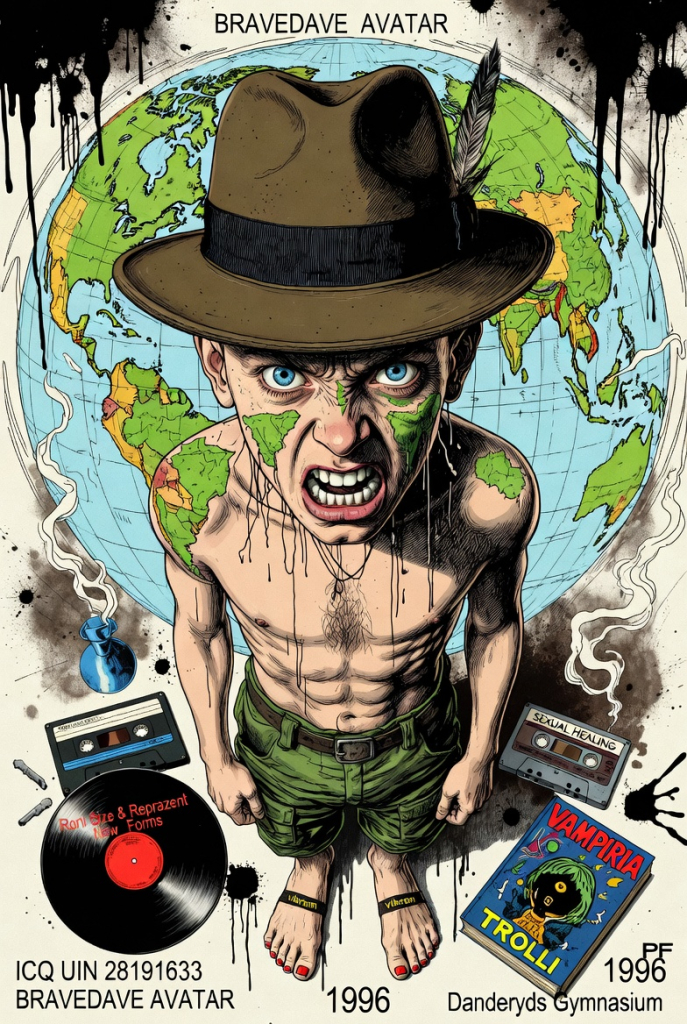


It was the beginning of September 2001, just before I was about to embark on my Mormon mission. I had finished all my preparations: wrapping up my jobs, saying goodbye to almost all of my friends, and selling all my movies, CDs, and other possessions. I invested everything I had into making this journey possible because I wanted to pay for it myself. I had also self-published As a Man Thinketh by James Allen in my own edition and given it to the most significant people in my life—Christer, Emil, Dalin, and Anna-Clara.
That evening, my friends—Müller, Polbratt, Thor, their girlfriends, and a few others—had invited me to a farewell party at Polbratt’s apartment near Telefonplan in Stockholm. Late into the night, everyone drank heavily except for me. They expressed their happiness through tears, shared love, and warm hugs, telling me that what I was about to do seemed dubious, but beautiful and important.
I didn’t say much, but I felt a deep connection of joy and care for my friends. It was their way of showing love, rooted in the Swedish culture we had all grown up with and explored together. Venturing into the Mormon discipline, I saw nothing wrong with the Swedish way of life—it was just another way of celebrating existence. Two opposing worldviews—Swedish secularism and Mormon esotericism—that could, perhaps, merge and even complement one another. Creating this synthesis had been a complex challenge for me throughout my life, and now, as I prepared to leave on my spiritual adventure, I was unsure of where it would ultimately lead. Still, I felt deeply called to take this leap of faith.
Around one o’clock, Müller and I decided to head back to Täby. We stepped out onto the street and hailed a taxi as soon as we got the chance. Once inside, Müller—with tears streaming down his face—began rambling about his unending love for typography.
“You don’t understand, David!” he sobbed. “Symbols, signs, letters, words… TYPOGRAPHY IS EVERYTHING! DON’T YOU GET IT!?”
I had never seen him this drunk. Suddenly, the taxi driver in front of us couldn’t help but start chuckling, and then burst into uncontrollable laughter—an unsettling, destiny-laden laughter that I remember to this day. Looking at us in the rearview mirror, he said, after his spasmodic laughter subsided:
“I don’t think you know how right you are when you’re describing reality in that way,” —interrupting our conversation. He bore a striking resemblance to a blend of Einstein and Doc Emmett Brown from Back to the Future, with an added touch of Rick (from Rick and Morty). His white hair was untamed, standing out in every direction. His eyes, intense like lightning, conveyed a mix of authority and an extremely creative, playful spirit. He had a mysterious, smiling countenance, yet there was a constant vigilance in his demeanor, as if he were always ready to pounce or attack, his gaze darting in all angles.
Dressed in a black suit, he presented a very proper appearance—but it was clear he was no ordinary taxi driver.
What we hadn’t realized was that we were about to embark on a three-hour esoteric lecture about the nature of reality and its many unknown aspects. The man spoke about secret symbols hidden in Disney castles and children’s cartoons from the nineteenth century. He claimed that Walt Disney himself had been selected by a mysterious phalanx of Freemasons to influence the children of his generation by embedding timeless symbols of creation and magic in his artwork, especially in films like Fantasia and Snow White.
He went on to explain that he possessed a kind of photographic memory, enabling him to remember everything he had ever experienced vividly—like his memories were magical structures, akin to a time machine he could re-enter and experience again and again, even changing them as he liked.
He also described his inability to block images from his mind and likened his brain to a highly disorganized library. His major challenge, he said, was to reorganize this vast array of information within himself to be able to experience a normal life again.
The lecture touched on a variety of topics—plants, consciousness, blood, covenants, secret societies, the structure of reality, words, spells, and much more. Finally, he revealed that he was an advanced “Wicca magician.”
Then Müller, still deeply emotional, said, “Yeah, David is interested in that kind of stuff. He recently went through the Mormon temple, was pressured to make secret covenants under threat, and is now going on a two-year mission where he’ll preach about God, Joseph Smith, and eternal celestial life.”
The taxi driver turned slightly, glancing at me again through the rearview mirror.
“Oh, so you’re going to be an Elder? But you don’t really believe that shit about the Book of Mormon, do you? It’s not as old as it’s claimed to be. It’s a radical alternative historical description of the world, used to create another dimension of reality—a ‘heaven,’ a ‘universe B,’ so to speak—a shared social psychosis so strong that it’s practically impossible to escape once you’re fully invested in it. And by the way, the whole organization is secretly run by a Satanic part of the Freemasons.”
There was a long silence before I finally, nervously said, “Well, I guess I’m going anyway.” I didn’t know what else to say. I had already gone to the temple, made the covenants, my hair had grown back, everything had changed. I had given all my money to my father and the church and sold all my possessions. But most importantly, God seemed to have spoken to me through an experience of flaming divine love that I had never encountered before—one that felt unique to me, as I had never heard of anyone, inside or outside the church, who had claimed to have experienced the same.
“Well, good luck, Mr. David. I’m sure you’ll have a very interesting adventure. But for the record, I think it’s much more interesting to give a big ‘FUCK YOU’ to Mr. God up there in the skies. By the way, I need to get going—give me a call someday. Here’s my card. I’d love to have a drink some night and get wasted with you fine, young, clear, intellectual guys.”
What did he mean by all of this? What was he inviting us to?
Müller and I got out of the taxi at the bus stop near the field in Gribbylund, where we both lived at the time. It was half past three. The taxi driver’s lecture had lasted over three hours. Müller turned to me and said, “This was probably the most important night of my life.” He gave me a hug, and then we parted ways.