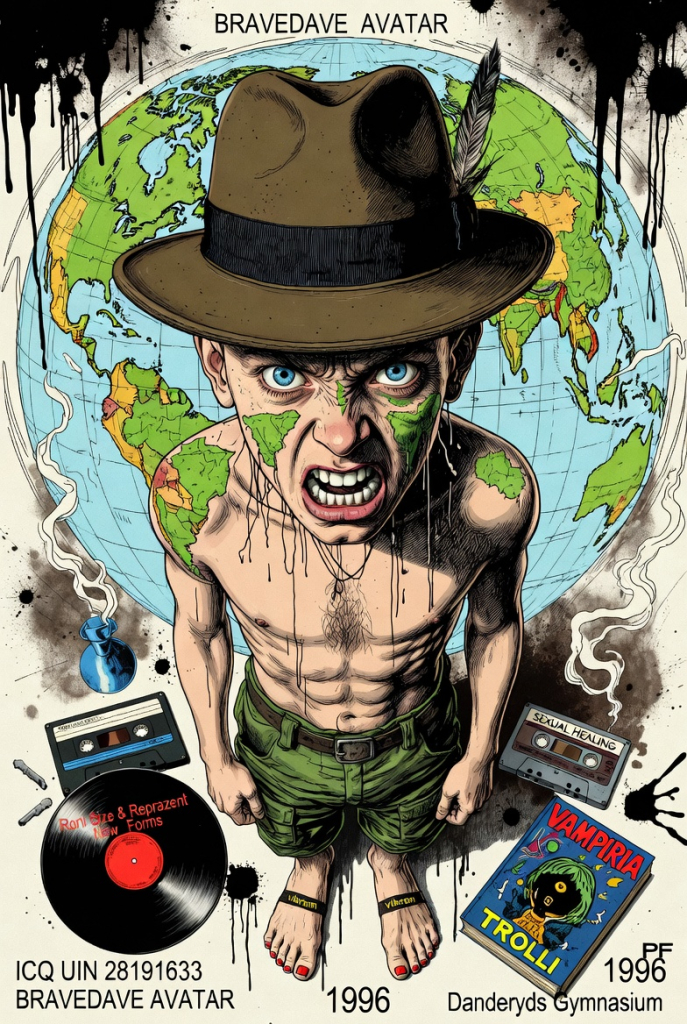

APHEX TWIN IN THE DARKROOM
I spent countless hours after classes in the school’s darkroom, developing the photos I took with my dad’s SLR camera. There was something magical about watching the exposures come to life through the chemical baths under the soft red light, with underground music playing in the background.
I became somewhat fixated on capturing the delicate tendrils of smoke and discarded cigarette butts, developing them with extremely high contrast to emphasize the intensity of the experience. I would deliberately file the edges of the enlarger’s negative carrier to create an artistic border around the black-and-white prints, adding a unique, handmade frame to each photograph.
However, I was still disoriented and depressed, feeling as if I was directing all my energy towards hiding my true self and projecting an outer image meant to convey that everything was fine. I remember one time, standing alone at the bus stop in the street, tears streaming down my face. I couldn’t do it anymore—I didn’t want to live this way.
One evening, late at night, I was at some Mormon friend’s house. ZTV was on, and as my friends slept on the couch, a disturbing music video started playing. It opened with an old woman wandering through a desolate urban landscape of gray concrete skeletons and empty buildings, with a large Rottweiler by her side.
A smashed television in a puddle, surrounded by chaotic trash, suddenly began sparking as the dog walked by; and then the dog starts barking uncontrollably as a crazy, malevolent face on the screen begin screaming, “I want your soul, I’ll eat your soul, I want your soul! Come to daddy! Come to daddy!” Then, a group of children, all wearing masks with the same twisted, bearded face, starts running around, destroying the neighborhood to the beat of harsh, intense, and vicious techno.
I was completely captivated by this cyberpunk expression, and made sure to remember the artist’s name: Aphex Twin. The next day, some new friends and I searched the school’s internet for this strange music video. All we found was an MP3 file titled “Alberto Balsalm.” The sound here was completely different from the one that had haunted me the night before—some lonely, sparse drums, reluctant synths, dancing together in their own self-created universe—but with a self-confidence, that had complete reassurance in it’s own geometrical form. “Clean,” Eebo said; the guy who knew more about music than any of us and always had the final say on all current trends.
I ordered the “Come to Daddy” EP from an online CD store. When it arrived, I soon realized I had discovered a soundscape unlike anything I had ever heard. The infamous “Come to Daddy (Pappy Mix)” hit me with a furious, chaotic energy—more like a magical cleansing than conventional music. The accompanying video, directed by Chris Cunningham, with its dystopian, cyberpunk, and alien horror psychopathic elements, is something you never forget after seeing.
Then came the second track, “Flim”—a complete contrast to the madness before it. It was one of the most pure and beautiful melodies I had ever listened to, conjuring dreamlike images of my younger self running carefree through infinite fields, clutching after helium balloons.
And then there was “Bucephalus Bouncing Ball,” where the sound of a ball dropping on a hard surface gradually morphs into a chaotic symphony. The sample is twisted and recreated into something very absurd but mesmerizing, as if the musical structure itself is unraveling and reassembling before my ears, completely ignoring the boundaries of what I thought was possible in sound.
At the time, I had no idea that this EP—this collection of rare tracks that felt so uniquely random and personal to me—would go on to be recognized as one of the most innovative and influential releases in the history of electronic music. The cover art was designed by the audacious British design firm, Designers Republic. Art Directors for the cultish Playstation game WipeOut, also embodying this rebellious spirit; persistently claiming that the customer is always wrong.
MUSIC OF THE MILLENNIA
On October 14, 2000, Johan and I traveled to South London to attend “The Incredible Warp Lighthouse Party.” Warp Records was the label that at the time, was releasing some of the most unexpected and groundbreaking music in the world.
Warp hosted the soundtrack to humanity’s digital transformation of reality, featuring artists and DJs like Aphex Twin, Autechre, Boards of Canada, Plaid, Bogdan Raczynski, Chris Cunningham, Prefuse 73, and Mira Calix.
These sonic innovators were the global melting pot of experimental creativity, where the biggest stars in the world sought inspiration when they wanted to revamp their style—aural structures and synchronies intuitively crafted from sublimely innovative sounds.
Johan spent the week scouring obscure record shops, hunting down the rarest and most unique special vinyl editions. But now, here we were, in the midst of the chaos—a determined group of music enthusiasts lined up, waiting to enter the party. I wore my dark green Helmut Lang jacket and had a freshly shaved head.
Beside me in the queue was a short, slightly freckled girl who had styled her dark hair into several spontaneous tufts. She was dressed in a gray, bizarrely gown-like outfit and had an unusually bold demeanor for someone so petite.
I asked, “You’re Björk, aren’t you?” With a teasing smile and an Icelandic-British accent, Björk replied, “Not tonight,” while shrugging her shoulders flirtatiously. it hadn’t been long since I had bought all her music videos on DVD.
Sometime after three in the morning, Plaid had just finished a set and began pumping out melodies from ‘Porn Coconut Co’ across the dance floor—the orchestral, layered and compounded harmonies from their then-unreleased album Double Figure, now renowned for its resonances that in many ways resemble Bach’s more intricate fugues.
Like an Icelandic Pippi Longstocking, Björk skipped across the dance floor to its center, delivering the most bizarre, whimsical, and genuinely unpolished choreography imaginable. Simultaneously, Bogdan Raczynski, another of the evening’s musically eccentric geniuses, joined the dance and matched her with an equally peculiar display of spontaneous, spasmodic movements, in perfect sync with Björk’s wild outbursts.
Words fail to capture the superhuman, architectural vortex of sound, light, tastes, scents, and animalistic, mechanical, and electronic functions, all intertwining in endless emotional explosions before my eyes, within and beyond my heart, through my body. It was a creative process without equal, uniting microcosm and macrocosm in one of the world’s grittiest docklands outside London, late on the night of October 16, 2000.
Back in Sweden a few days later, I learned that the rave commission had raided my café on David Bagares Gata, where I was living at the time. How was I supposed to interpret this? The place seemed empty in the early morning light, and I saw no signs of police activity or any damage related to my or Dante’s belongings as I searched the rooms—until I opened the bathroom door. There, I found an Asian, somewhat androgynous guy with a mohawk, his eyes half-open, seemingly asleep, with a big needle in his left arm. “It’s time to get out of here,” I thought to myself once again, a thought I had had many times before.
And when I did, I had my religious dream.